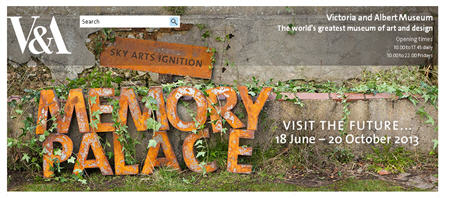
Memory Palace is a ‘walk-in book’ at the V&A museum in London
At the weekend I took a break from the London sunshine and went to see Memory Palace, a ‘walk-in book’ at the V&A museum. It is an exhibition described by its curator Sky Arts Ignition as ‘a new work of fiction by the author Hari Kunzru with 20 commissions by leading graphic designers, illustrators and typographers to create a multidimensional story’.
Why create a book in the form of a multimedia exhibition in a museum? How is it different to a story told orally, or in book or digital reader form, and is the experiment worth the effort? And is this one of the possible ways readers, if that’s still the relevant word for us, will experience fiction in the future?
In Memory Palace you ‘read’ (or immerse yourself in?) the story by walking through an exhibition that includes text, installations, graphic novel elements, video, typography, illustrations and an internet connection. You have the option of breaking out of the linear order of the narrative by choosing not to view exhibits in the order they’re presented, you can touch some of the surfaces and you can choose how long you spend on each part. You have to stoop and even get onto the floor to see read some of the script. Visitors were talking to each other as they walked around and one pair, who looked like a father and daughter, seemed to be more interested in whatever was on their mobile phones.
The story itself is speculative fiction about a dystopian future and feels as if it could have been written as a graphic novel, partly because of the subject and the basic level of characterization and also because graphic novel styles are used to convey a lot of the action. There are no doubt numerous SF and fantasy novels along similar lines but the themes and concept of Memory Palace probably place it closer to literary ‘slipstream’ such as Will Self’s ‘Book of Dave’. Correct me if I’m wrong.
At the end you get to add your own contribution via email which means the story continues after each visitor leaves the exhibition, and you become a collaborator. You are asked to write an answer to the question: ‘If you were only able to pass on one memory to future generations what would it be?.’This was the most emotionally engaging moment for me.
In the story the narrator is imprisoned by ‘The Thing’, a brutal group who want to destroy human memory and return humans to a wild state. While imprisoned, the narrator uses a technique to recall his memories: the ‘Memory Palace’. This is the central motif of the story and one of the things that really works is the way the themes are embodied in the form the story takes. This couldn’t be achieved with a book. After experiencing the Memory Palace we remember it partly in relation to the positioning of the different exhibits, in the same way the protagonist remembers his past. The idea of the memory palace is based on fascinating research, and sources dating from the classical period to around the 18th century are cited in the exhibition.
Signs, such as numbers and words, are prohibited in the world of the story because they relate to memory, so naturally numerals and type are used extensively in Memory Palace. The story is thematically layered and themes include the way that being able to remember through codes and signs prevents us regressing to primal aggression and determines our destiny. Without memory we are unable to evolve and unable to negotiate our conflicting views and needs.
Memory is a fragile faculty in the story, with both the oppressors and the oppressed having unreliable notions of the ‘Boomtime’, our own historical period. The way memories and language are interpreted allows Kuzru to inject some humour and irony. For example, a ‘manager’ is understood as ‘Those who barely got by, who could not live in a world of such quickness, and starved’, while the internet is ‘A conspiracy of fools and knaves, a plot against nature’. (To be fair, the jury is still out on the latter.)
The V&A is an interesting place to stage a piece like this, with tourists jostling for tickets for the current Bowie show, or shuffling bored through halls full of marble bottoms and writhing torsos.
How original is the idea? The show builds on ways in which visual art and literature have been combined before, in graphic novels or art movies, for example. And narrative elements have always existed in art. Victorian paintings are like visual Dickensian moral tales, while much art historically has been based on classical mythology, or presents allegories that the viewer needs to know how to decode.
Modern artists combine text and narrative elements too, with Tracey Emin a famous example and her piece ‘Everyone I Ever Slept With’. Having seen Memory Palace I think the idea of narrative told in 3D spaces could be taken further. Adding audio is one obvious way. I did wonder if the story ought ideally to have been developed from the outset as a 3D concept, whereas this show seems to be a case of artists interpreting literature after the event.
That said, anyone who is interested in experiments in combining literature and visual art or in experiments in story telling should try and get along. The exhibition is on until 20 October.
If you’re not convinced you can always just buy Kunzru’s book in the museum shop and read it on the bus home.
 Fiction and other stories