How and why I wrote my novel ‘Wrecker’

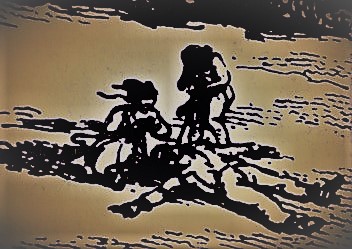
Close up of women wreckers

My novel ‘Wrecker’ came out in paperback last week, so this seems a good moment to explain why and how I came to write the story. 

So what’s ‘Wrecker’ about?

‘Wrecker’ is a wild and stormy tale, dark and gothic, full of dramatic incident and intensity. It  tells the story of Mary Blight, a feisty young woman who refuses to stay in her place and risks all to get what she wants.

At the beginning of the story, we don’t see her in the best light as she pilfers from corpses washed up on the beach after a shipwreck. But Mary is desperately poor, grinding out an existence in a remote village on the Cornish coast and grasping at any little luxury within her reach – coins, trinkets or clothes.  

Mary’s life is turned upside down after she rescues a stranger who washes ashore, strapped to a barrel. Gideon Stone is a charismatic Methodist preacher, who decides to build a chapel in Mary’s village, Porthmorvoren.  

Mary becomes obsessed with Gideon and this turns her neighbours against her and brings her misdeeds to the attention of the great and the good, ultimately putting her in mortal danger.

Where is the story set?

The action takes place in the fictitious village of Porthmorvoren in Penwith, West Cornwall. It is located somewhere between Newlyn and Land’s End, but you won’t find it on any map. Porthmorvoren is an amalgam of several villages I visited on Cornish holidays, including Mousehole, Port Issac, St Ives and Newlyn. The haunting atmosphere of the ruined and deserted village of Port Quin on the north Cornish coast was also an inspiration.

What gave me the idea of writing a book set in historic Cornwall?

On holiday in Cornwall I saw a picture on the cover of a book called ‘Lost Cornwall’ by Joanna Thomas. It showed a young girl carrying pails of water down a lane in gritty nineteenth century Newlyn. As I read about Cornwall’s past, the remote setting, the pagan superstition and wild Cornish coastline all convinced me to begin a story about wrecking, poverty and betrayal.

I didn’t want to portray a corny picture-postcard version of Cornwall, as I explained in an article in Historia magazine. The Cornwall of ‘Wrecker’ is dark, gritty and gothic.

In a way the most important character in the novel is Cornwall itself – the heroine Mary Blight is a kind of spirit of historical Cornwall, embodying its characteristics, for example, distrust of ‘uplongers’ (outsiders), rugged individualism, a sense of closeness to the land, and what has been described as Cornish ‘fire and urgency of soul’.

Belatedly, I discovered ‘Wrecker’ belongs to a tradition of fiction set in Cornwall – Winston Graham’s Poldark novels, and numerous mass market fiction writers, notably Rosamunde Pilcher who sold more than 60 million copies of her romances.

While I was researching the novel, I also discovered that Wrecker’ is a belated example of a 19th and early 20th century literary subgenre of books about Cornish wreckers and Methodists.

Is ‘Wrecker’ based on real events?

All of the events happened somewhere at some time in Cornwall, but the story is entirely original.

For example:

Mary Blight discovers a dead woman, a shipwreck victim, has had her ear lobes chewed off. This was inspired by a documented incident in the Scilly isles where a woman chewed off a woman’s ear lobes to steal her earrings.

A man is washed ashore lashed to a barrel. This is based on an event in Port Isaac in the early twentieth century. A fisherman who couldn’t swim was saved by his workmates in this way when his boat began to sink. Sadly, his mates all perished. 

Two characters are stitched together by a seamstress during a Methodist chapel meeting to expose them as adulterers. This is based on a documented incident in the 19th century when a woman sewed two young people together to punish them for flirting during a service. 

Mary Blight – what are you like?

Anyone who feels constricted in their life, and sees others enjoying luxuries and freedoms that are out of their reach, should be able to relate to Mary. She is:

  • Based on an archetype of a headstrong, proud, impulsive young woman;
  • True to herself – not a hypocrite;
  • Someone who baulks against poverty, and also struggles against social and gender constraints;
  • Wily and resourceful;
  • A woman who speaks her mind and has a sharp tongue, which makes her enemies;
  • Transgressive, sexually assertive, a seductress;
  • A pagan at heart, who sees the world through different eyes to us, believing in pagan superstitions and using charms.

During the story Mary changes. She is ‘born again’ under the influence of Gideon Stone, and her conscience is pinched about her past misdeeds in the same way her toes are pinched in the boots she has stolen from a corpse.

What were my influences?

Surprisingly perhaps, I wasn’t influenced by Daphne Du Maurier, as I had not read any of her novels. Perhaps I should have read ‘Jamaica Inn’ and ‘Frenchman’s Creek’ but I didn’t get around to it. After ‘Wrecker’ was published in hardback, I read ‘Rebecca’ and was hugely impressed with it, especially the way Du Maurier draws us into complicity with the unnamed narrator.

The main influence for ‘Wrecker’ was Thomas Hardy’s novels, especially ‘Tess of the D’Urbervilles’ and ‘Jude the Obscure’.

What gave me the idea I could write a novel from a woman’s point of view? 

I did not set out to tell the story from Mary’s point of view. However, Mary’s voice was too compelling to ignore and telling the story from her point of view helped to focus the narrative.  

Many male writers have written convincingly about female characters and vice versa. They include Flaubert, Tolstoy, Henry James and Jeffrey Eugenides, and I have written and an article about this.

Ideas about gender are currently being hotly debated. Perhaps Simone de Beauvoir’s famous quote should have the last word: ‘One is not born but, rather, becomes a woman.’ 

Does ‘Wrecker’ resonate with today’s world?

The novel touches on the position of women in society, social justice, crime and religion. Mary is caught in a toxic melting pot of stifling conformity, social injustice, increasing class distinctions, the rising consumer society.

The context of the British empire and the morally questionable basis of its wealth and power remains relevant to today’s Britain, convulsed by arguments about Brexit driven in large part by myths about our national history and nationalistic ideology.

What are the themes of ‘Wrecker?’

The title ‘Wrecker’ is metaphorical as well as literal, inviting the reader to ponder who or what is the real ‘wrecker’ in the story. Is it Mary Blight or Gideon Stone, or is the wrecker an abstract notion such as love, injustice or even stifling and repressive conformity?

Love is clearly a theme – the story is largely driven by Mary’s attempt to get Gideon to acknowledge his unconscious feelings for her. There are other competing forms of love in the story too, the  ‘perfect love’ offered to the faithful in the life to come, and love of kin.

While most historical fiction tells the story of the great and the good, I wanted to tell the untold story of a poor person, a face in the crowd, putting her actions in the context of the time in which she lived. The novel imagines how poverty can drive people to dark deeds, and shows the double standards between the better off and the poor.

Religion is another theme in the novel. I aimed to give a balanced view of the impact of Methodism in Cornwall. On the one hand, the novel shows Methodism as a positive force, for example in helping to allow women a social role outside the home, and helping the poor aspire to a better life. On the other hand, Methodism can be seen as an instrument to keep the poor in order, sober, self-reliant and firmly in their place. Another theme is the danger of religious certainty. Gideon Stone’s fundamentalism and messianic zeal make him blind to his own underlying motives and reluctant to take account of the flaws in his character.

‘Wrecker’ is sympathetic to women who want to raise their social station and assert their independence, and it shows women helping each other. However, the story also shows women can compete against and hinder each other, especially in their traditional role policing the morals of small communities and shaming offenders to comply – sometimes in very nasty ways.

How historically accurate is the story?

I avoided the clichéd myths about wrecking such as ‘false lights’ and the drowning of survivors for which there is no documentary evidence. Wrecker also shows the other side of the story, how the forerunners of today’s lifeboat service tried to rescue people, usually at great risk to themselves.

Mary Blight’s actions may resonate with modern women, but I tried to make her a woman of her own time in the 1820s. People think of the 19th century as the Victorian era but Victoria came to the throne in 1837. In Mary’s time, pre-marital sex was common and women were often pregnant when they married. The preoccupation with ‘fallen women’ came about later in the century.

How did I research the book?

I used many books and websites to research Cornish social history, but three formed the bedrock of my research:

‘Wrecker’ is published by Harper Collins HQ and available in Waterstones, WH Smith, independent bookshops and online in print, audio and digital formats.  
Nanowrimo: a novel in a month, bish-bash-bosh, job done?

Ready to write a novel?

Ready to write a novel?

I did nanowrimo in 2013. Me and 380,855 other people. And we’re all going to be famous writers just as soon as we’ve polished up our manuscripts.

For anyone who doesn’t know, nanowrimo means national novel writing month. It’s an online community where members commit to writing 50,000 words or more during the month of November. The idea is that writers  support each other as they push they push through the pain barrier and get that first draft nailed. 

I’ve got a major misgiving about nanowrimo. Not all longer works of fiction can be written in a month,  a year or even a decade.  Despite this, the publishing industry regularly forces writers to produce a novel in a year, or less. Should we really be encouraging this?

I’m not against deadlines. As a journalist I know the advantages of having to submit copy by a given date.  But we already have a situation where publishers compel writers to finish books to deadlines that reflect commercial imperatives but show little concern for quality or the creative process. Publishers  gush over an author when they sign the book deal but once the ink has dried they exploit their unequal relationship with authors to force them to produce books to an unrealistic timescale. Then they blame the author if nobody wants to read the book.

You could argue that tight deadlines help focus the mind, especially when writing overtly commercial books, and the same might apply to some highly formulaic genres or sub-genres (I know of one writer contracted to produce two steampunk novels a year, for instance). A rushed manuscript might be a work of towering genius or a best-seller. Then again, it might be trite and derivative – or just a mess. The point is that writing shouldn’t be a race against time; it should be a quest for the Holy Grail.

Having said that, nanowrimo was a worthwhile experiment for me.  I needed to do something drastic to prove to myself that I was committed to writing after a couple of years of  going round in circles, producing self-indulgent wish-fulfilment twaddle that amused myself but probably wouldn’t excite The Reader.

In the run up to last November, I spent about six weeks writing an outline and notes on the main characters, as well as doing some research, which was unavoidable as I perversely decided to set  the story during the Napoleonic Wars. In November 2013 I succeeded in producing  50,000 words, but did the process take  me any further than I would have reached with a slow, patient approach? And will nanowrimo ultimately help me to get a first draft finished more quickly than taking my time would have done? I’m not sure.

Here are a few personal pros and cons of doing nanowrimo, but I’d be keen to share experiences with others who’ve tried it.

Pros

  • It reminds you of the value of spending some of your available writing time just forcing yourself to develop narrative. I’ve learnt over time that spending ages planning out a novel in advance or nailing a character’s every trait and entire biography can produce static fiction. We should remember what ‘drama’ means: the thing done. The gun-to-the-head approach forces you to bring characters together and put them in conflict, and to generate what happens next.
  • Having a community that supports you, and competes with you, generates momentum in itself, and the graphic that charts your progress each day against your target is a great motivator.
  • You’re forced to to carry on writing when you don’t feel like it, and that can lead to discoveries you might not have otherwise made (writer’s block is for cissies).

Cons

  • You end up writing drivel just to meet the target wordcount. When out of narrative steam, I  padded the story out with description which is one of the avoidance habits I was trying to shake off.  
  • The time pressure mitigates against trying things out (e.g. exploring the story from a different point of view, or testing out alternative actions or motivations for a character).  On the other hand, you learn what your default tactics are and that might help you move beyond them at a later date. 
  • The subconscious/unconsious may not have time to work, solving problems that your analytic mind can’t. 
  • You have to write when you’re stale and what you produce is often stale too.  
  • Creating stories at speed can lead to crude black and white character motivation and themes. Which might not be a problem for everyone. 
  • At the end you post your masterpiece into a void, and you get no feedback.  

So would I do nanowrimo again? Yes, probably. But next time I’d give myself different rules. For example, I might start with a couple of characters and a premise and commit myself to trying out at least five alternative ways to develop complications at every stage. So on the whole I’d recommend at least giving it a try. 

Memory Palace

With ‘Memory Palace’ fiction goes 3D but does it work?

Memory Palace

Memory Palace is a ‘walk-in book’ at the V&A museum in London

At the weekend I took a break from the London sunshine and went to see Memory Palace, a ‘walk-in book’  at the V&A museum. It is an exhibition described by its curator Sky Arts Ignition as ‘a new work of fiction by the author Hari Kunzru with 20 commissions by leading graphic designers,  illustrators and typographers to create a multidimensional story’.

Why create a book in the form of a multimedia exhibition in a museum? How is it different to a story told orally, or in book or digital reader form, and is the experiment worth the effort? And is this one of the possible ways readers, if that’s still the relevant word for us, will experience fiction in the future?

In Memory Palace you ‘read’ (or immerse yourself in?) the story by walking through an exhibition that includes text, installations, graphic novel elements, video, typography, illustrations and an internet connection. You have the option of breaking out of the linear order of the narrative by choosing not to view exhibits in the order they’re presented,  you can touch some of the surfaces and you can choose how long you spend on each part. You have to stoop and even get onto the floor to see read some of the script. Visitors were talking to each other as they walked around and one pair, who looked like a father and daughter, seemed to be more interested in whatever was on their mobile phones.

The story itself is speculative fiction about a dystopian future and feels as if it could have been written as a graphic novel, partly because of the subject and the basic level of characterization and also because graphic novel styles are used to convey a lot of the action. There are no doubt numerous SF and fantasy novels along similar lines but the themes and concept of Memory Palace probably place it closer to literary ‘slipstream’ such as Will Self’s ‘Book of Dave’. Correct me if I’m wrong.

At the end you get to add your own contribution via email which means the story continues after each visitor leaves the exhibition, and you become a collaborator. You are asked to write an answer to the question: ‘If you were only able to pass on one memory to future generations what would it be?.’This was the most emotionally engaging moment for me.

In the story the narrator is imprisoned by ‘The Thing’, a brutal group who want to destroy human memory and return humans to a wild state. While imprisoned, the narrator uses a technique to recall his memories: the ‘Memory Palace’. This is the central motif of the story and one of the  things that really works is the way the themes are embodied in the form the story takes. This couldn’t be achieved with a book. After experiencing the Memory Palace we remember it partly  in relation to the positioning of the different exhibits, in the same way the protagonist remembers his past. The idea of the memory palace is based on fascinating research, and sources dating from the classical period to around the 18th century are cited in the exhibition.

Signs, such as numbers and words, are prohibited in the world of the story because they relate to memory, so naturally numerals and type are used extensively in Memory Palace. The story is thematically layered and themes include the way that being able to remember through codes and signs prevents us regressing to primal aggression and determines our destiny. Without memory we are unable to evolve and unable to negotiate our conflicting views and needs.

Memory is a fragile faculty in the story, with both the oppressors and the oppressed having  unreliable notions of the ‘Boomtime’, our own historical period. The way memories and language are interpreted allows Kuzru to inject some humour and irony. For example, a ‘manager’ is understood as ‘Those who barely got by, who could not live in a world of such quickness, and starved’, while the internet is ‘A conspiracy of fools and knaves, a plot against nature’. (To be fair, the jury is still out on the latter.)

The V&A is an interesting place to stage a piece like this, with tourists jostling for tickets for the current Bowie show, or shuffling bored through halls full of marble bottoms and writhing torsos.

How original is the idea? The show builds on ways in which visual art and literature have been combined before, in graphic novels or art movies, for example. And narrative elements have always existed in art. Victorian paintings are like visual Dickensian moral tales, while much art historically has been based on classical mythology, or presents allegories that the viewer needs to know how to decode.

Modern artists combine text and narrative elements too, with Tracey Emin a famous example and her piece ‘Everyone I Ever Slept With’. Having seen Memory Palace I think the idea of narrative told in 3D spaces could be taken further. Adding audio is one obvious way. I did wonder if the story ought ideally to have been developed from the outset as a 3D concept, whereas this show seems to be a case of artists interpreting literature after the event.

That said, anyone who is interested in experiments in combining literature and visual art or in experiments in story telling should try and get along. The exhibition is on until 20 October.

If you’re not convinced you can always just buy Kunzru’s book in the museum shop and read it on the bus home.

Never mind the bollocks, give us real working class voices

In his article in The Guardian this week “Crime fiction: the new punk?”  Adrian McKinty states ‘it’s pretty obvious that British fiction has been moribund for decades’ and, he claims, this is because of a clique of public school toffs with no ear for the demotic trying to write about the working classes (that’s enough about Martin Amis).

Adrian argues that the ‘whole literary fiction cadre’ should be ‘re-invigorated’ by  crime fiction in the way that the boring old farts of 1970s prog rock were pushed aside (for a short while) by punk. But Adrian’s claim that ‘Crime fiction, especially noir and hard boiled, are the fiction of the proletariat’ is a dodgy premise. This is surprising, perhaps, for someone so keen on crime fiction, where having a good premise is seen as critical. If  Adrian  made the same argument about the ‘Clogs and Shawls’ books that used to sell in shed-loads  he’d be on to something. But clogs and shawls aren’t very punk, are they?

Before I start my rant, I agree with some of Adrian’s points. Who can disagree with the view it is time to dump the ‘literary fiction’ label (which is only another genre after all)? But I don’t think that means writers should turn to writing books that fit neatly into a genre or sub-genre. Surely, rigid market segmentation is as likely to stop new voices being heard as to facilitate it. I do agree though that we should be able to hear the authentic voices of characters who aren’t middle class. Banning the ‘campus novel’ would be a good start. Sorry about that, Zadie.

But after from that I fundamentally disagree with Adrian so… Hey ho, let’s go. I challenge the assumptions behind the article that:

  • Crime fiction is working class.
  • Crime fiction is edgy and rebellious, like punk. 
  • Crime fiction is the solution to re-invigorating the allegedly moribund state of English literature (not Scottish or Irish literature because they’re dead edgy and there’s lots of social mobility over there, apparently). 

On the class issue, the knee-jerk association of working class people with crime and violence is not authentic. Working class people are not a homogeneous lump. This is a stereotype, in complete contradiction to Adrian’s laudable desire to hear the demotic and surely falling into the same trap as Lionel Asbo/Keith Talent? Far from being fun-loving criminals, most working class people are obsessed with respectability because they’ve got no money to back them up if they lose their reputation. Seen the employment rates of ex-offenders lately?

Quoting Morrissey saying “it says nothing to me about my life” as an example of a working class hero alienated by bourgeois culture tells you how Morrissey feels but not a lot else. Morrissey may be genuinely alienated but the hero of the (not particularly working class) 1980s Indie audience (white boys to a man) is so peculiar and unique he can only represent a demographic of one. I’m not sure what they’d make of Morrissey down a traditional  working man’s club.

Writers should give working class characters the same uniqueness they give to middle class characters (difficult, because the only working class people most writers know are the ones they talk to in call centres). It’s time writers stopped using stock working class types out of central casting as representative ciphers, vehicles for making social comments or addressing the big issues. ‘Shameless’ style caricatures aren’t the way to give the working class,  under class, a voice. If middle class characters are allowed to be complex and unique in fiction then so should everybody else.

I agree that punk was in part a working class grass roots movement (I come from Harlow in Essex and am so old I was there when punk happened, watching local bands like the Neurotics, The Sods and The Gangsters  – yes, these were real bands). But we were a small sub-culture, not representatives of ‘blue collar’ people in general. While we were getting our heads kicked in by skin heads the soul boys were down at the disco kicking shit out of each other to the dulcet tones of the Stylistics. And as Adrian says, punk changed little and what followed was the Thatcher years.

As for crime fiction being edgy and rebellious, right now what could be more safe, market friendly, conformist and tried and tested? It’s an unadventurous  publisher’s dream genre.The only real connection between punk rock is that both crime fiction and punk fans tend to be male and in their forties and fifties. Crime fiction is the Dad Rock of genres,  about as dangerous and cutting edge as what Rebus listens to in his car. (Yes, I know some young people like punk too).

Crime fiction isn’t especially focused on working class people anyway (even allowing for the, admittedly very good, examples Adrian gives in his article) and nor is its audience especially proletarian. The last word  in North London middle class (Guardian reading?) chic is a bookshelf full of Ian Rankin, Elmore Leonard and the Scandinavian noir writers.

What we need isn’t more stock characters or variations on a worn out theme, or murders for that matter, but real stories with real characters. By which I mean authentic and unique characters.

By the way, what is the ‘working class’ these days?

Welcome to my blog from the Welcome Trust

20130417-225512.jpg

Well, I was seeing whether the mobile WordPress app would work and it did so this is my first blog post. A test but in a way that’s the point, isn’t it. My daughter Georgia and I went to the Welcome Trust Collection in Euston, London recently. Georgia is doing a lot of work in her fine art foundation year on the body, and being lateral and creative, she thought of going to a science/medicine museum.

If you haven’t been I’d highly recommend it. There are lots of cabinets with drawers you can open and bizarre exhibits from around the world. This is lateral in more ways than one of course. I’m inching towards launching a writing blog and ultimately a website and this is part of the journey, an unexpected chance branch (like forgetting to get off at the right tube stop and having to take a different line) and maybe synergy. Start the way I mean to go on.

The picture is of an artwork exploring body image. It speaks for itself. The guy standing next to the artwork just happened to be there, but I like the way his posture and jacket make him echo the shape. Another random synergy.

Next time round I’ll work out how to wrap the text round the picture.